
Why Did My Permanent Makeup Brows Disappear? Understanding the Pigment Ghosting Phase

Updated: Aug 6
Why Do Microbladed and Nano Brows Disappear? Understanding the Ghosting Phase in Permanent Makeup Eyebrow Healing
Is It Normal for Microbladed Brows to Fade So Soon After Treatment?
You've just had your permanent eyebrow treatment—nano brows, microblading, or nanoblading—and for the first few days, they look beautifully defined. Then, around day 4–7, something alarming happens: your eyebrows seem to disappear. The colour fades dramatically, and you're left wondering if something went wrong.
This is the ghosting phase, and it's completely normal. It's one of the most common concerns I hear from clients, especially those with mature and sensitive skin. Understanding what's happening—and why—will help you relax and trust the healing process.
Could My Skin Type Be Unsuitable for Nano Brows or Microblading? My Permanent Makeup Brows Disappeared!
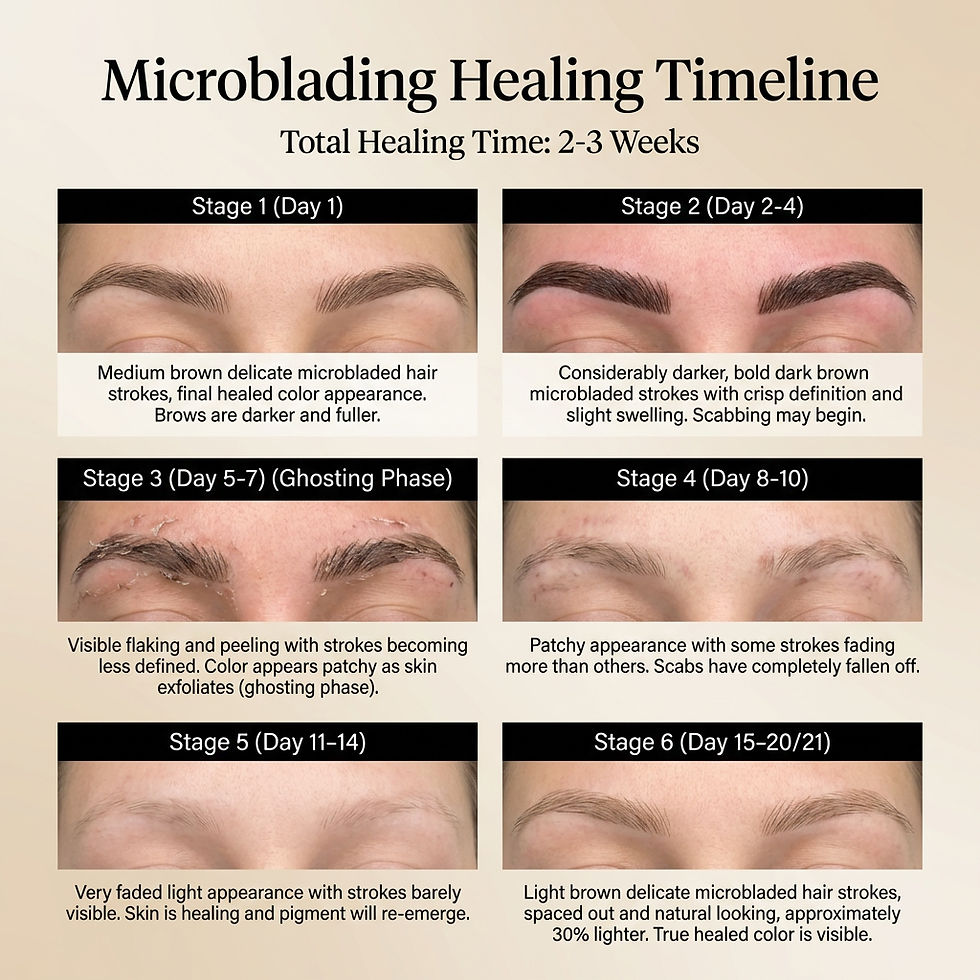
This is the most common concern many clients experience within only a few days from the treatment.
The "disappearance" of your eyebrows during healing isn't actually disappearance at all—it's a natural part of how your skin heals after permanent makeup, regardless of skin type, age, or characteristics. It happens almost always, but to a differing degree.
When pigment is implanted into the skin during nano brows, microblading, or nanoblading, your body immediately recognises it as a foreign substance and begins the healing process. This involves:
Inflammation and swelling: Your skin swells slightly, which can make the pigment appear darker initially.
Flaking and peeling: As the outer layer of skin (epidermis) heals, it naturally sheds. This is where most of the visible colour goes—it's not that the pigment is disappearing; it's that the top layer of skin carrying the pigment is exfoliating.
New skin formation: Right underneath, new skin cells form to repair the broken skin barrier. This skin layer is slightly opaque, temporarily covering the pigment. Within the next few weeks (4 to 6 on average), this layer will exfoliate naturally, revealing the colour deposited during the session.
Scabbing: Tiny scabs form as part of normal wound healing. When these scabs fall off, they may take some colour with them.
Your eyebrows may look dark and bold right after treatment if you have sensitive skin that responds easily to touch, is vascular, and bleeds excessively even with the slightest needle contact. This, in turn, can create thicker scabbing and more dramatic peeling, which may take some colour with it in the process.
Why Did My Nano Brows Disappear Just a Week After Treatment?
Yes, this is completely normal—and it happens with all permanent eyebrow techniques: nano brows, microblading, nanoblading, ombre shading and especially with traditional eyebrow tattoos.
The timeline typically looks like this:
Days 1–3: Your brows appear very dark and bold. Swelling is at its peak, and the pigment sits in the upper layers of skin.
Days 4–7: This is when the ghosting phase hits hardest. Your brows fade dramatically—sometimes by 40–60%—as the epidermis begins to shed. This can be alarming, but it's exactly what should be happening. Days 8–14: Flaking and peeling continue. Your brows may look patchy or uneven as different areas shed at different rates. This is normal and temporary.
Weeks 2–4: The healing slows down. Your brows gradually regain some colour as the skin settles and the pigment stabilises in the deeper layers (dermis).
Weeks 4–6: By the end of the healing period, your final colour emerges. This is typically 30–50% lighter than the initial application—and this is the true, lasting colour.
For mature and sensitive skin, this process can be slightly more pronounced. Mature skin often has a thinner epidermis and may shed more noticeably. Sensitive skin may experience more inflammation, which can affect how the colour appears during healing. This doesn't mean anything is wrong; it just means your healing journey may look a bit different.
Equal if not greater number of clients report a gentle, dandruff like flaking style, with colour slightly lighter, becoming gradually more pronounced, in a barely noticeable process.
What Should I Do When My Eyebrows Disappear?
The most important thing is to do nothing—and trust the process. Here's what I recommend:
During the Ghosting Phase (Days 4–14)
Don't panic: Your eyebrows are not ruined. The colour will return as healing progresses.
Keep them clean and dry: Gently pat them dry with a clean, soft tissue if you find yourself sweating or in a room full of steam.
Apply aftercare ointment sparingly: Use only the ointment recommended in your aftercare guide. Too much moisture and mechanical scab disturbing can affect colour retention.
Avoid picking or scratching: I know the flaking is tempting, but picking at scabs can remove pigment prematurely and cause scarring.
Skip makeup and exercise: Let your skin focus on healing without additional irritation or sweat.
Avoid sun, water, and saunas: These can interfere with the healing process and pigment retention.
Be patient with the appearance: Your brows will look uneven, patchy, and faded. This is temporary and completely normal.
After Healing (Weeks 4–6)
Once the initial healing is complete, you'll see your true, final colour. For many clients—especially those with mature skin—this is when a touch-up becomes valuable. A touch-up appointment (typically 4–6 weeks after the initial treatment) allows me to:
Assess colour retention and any areas that didn't take pigment as well
Add definition where needed
Refine the shape based on how your skin healed
Ensure even colour distribution
Touch-up pricing: Within 12 months of your initial treatment, touch-ups are £175/hr. After 12 months, they're £200/hr (first hour).
Is the Ghosting Phase Different for Nano Brows, Microblading, and Nanoblading?
All three techniques follow the same healing pattern, but there are subtle differences in how they appear during the ghosting phase:
Nano Brows: The ultra-fine needle creates very precise lines. During ghosting, these lines may fade more noticeably because they're so delicate. However, nano brows are ideal for mature and sensitive skin because the technique is gentler and the results are softer and more elegant.
Microblading: The manual tool creates slightly bolder strokes. During ghosting, the definition may soften, but the overall shape typically remains visible. Microblading is best for younger, more resilient skin.
Nanoblading: This hybrid technique combines the precision of nano with the definition of microblading. The ghosting phase is similar to nano brows, with a softer fade and gradual colour return.
Regardless of technique, the ghosting phase is temporary, and your final colour will emerge within 4–6 weeks.
Why Regular Touch-Ups Matter?
If your skin is characterised by a quick cell renewal rate, often stimulated by certain cosmetic products and supplements taken orally, or your skin is mature/ sensitive, an initial follow up, touch-up appointment soon after the initial session may be helpful, otherwise an average yearly gentle colour boosts are recommended. Here is why:
Supple skin with a speedy cell renewal, may need to build up more colour density initially, which needs to be done in stages, preventing over-saturation when attempted to be achieved in one sitting.
Mature skin may not retain pigment as evenly as younger skin, especially in areas with fine lines or texture changes, so it might benefit with a touch up appointment soon after the initial session.
Sensitive skin may experience more inflammation during healing, which can affect how the pigment sets. With time more colour builds up and eventually a gentle colour refresher yearly or every 18 months is a recommended for maintaining an elegant look.
A touch-up allows me to assess your individual healing response and make adjustments that ensure your brows look their absolute best. Building the colour density up gradually, without over-saturating the area in one go, and creating a merged together, heavy look that will soon change it's colour to unnatural is a much better long term approach, but requires certain amount of patience and trust on behalf of the client.
Key Takeaways
The ghosting phase (fading during days 4–14) is completely normal for nano brows, microblading, nanoblading, and all permanent eyebrow techniques.
Your eyebrows aren't disappearing; your skin is shedding as part of the natural healing process. By the time it begins to shed, you have become accustomed to a darker, stronger look, and the change creates a stark contrast. Even if you requested a very natural look initially, your perception has likely changed.
Mature and sensitive skin may experience a more pronounced ghosting phase, but this doesn't indicate a problem.
Trust the process, follow aftercare instructions, and avoid picking or interfering with healing.
Your true, final colour emerges around week 4–6
A touch-up appointment (within 12 months) is highly recommended, especially for mature skin, to ensure even colour and optimal results. However, some skin types preserve the colour for longer. Personal level of satisfaction also differs from person to person and changes with time: some will be thrilled to have a gentle, elegant, naturally looking template, that doesn't draw attention, whilst others are more comfortable with an enhancement that looks more like a traditional makeup—stronger and more saturated. In some cases, what was a perfect result after the first session, changes after a few years and a more noticeable look is requested.
If you have concerns during healing, refer to your detailed healing stages guide before contacting me with specific questions. Bear in mind in most cases, what you're experiencing is exactly what should be happening.
Your beautiful, natural brows are on their way. 🤍


Comments